
Last updated March 2026
⚖️ The Middle Ground in Florida Sexual Battery Law
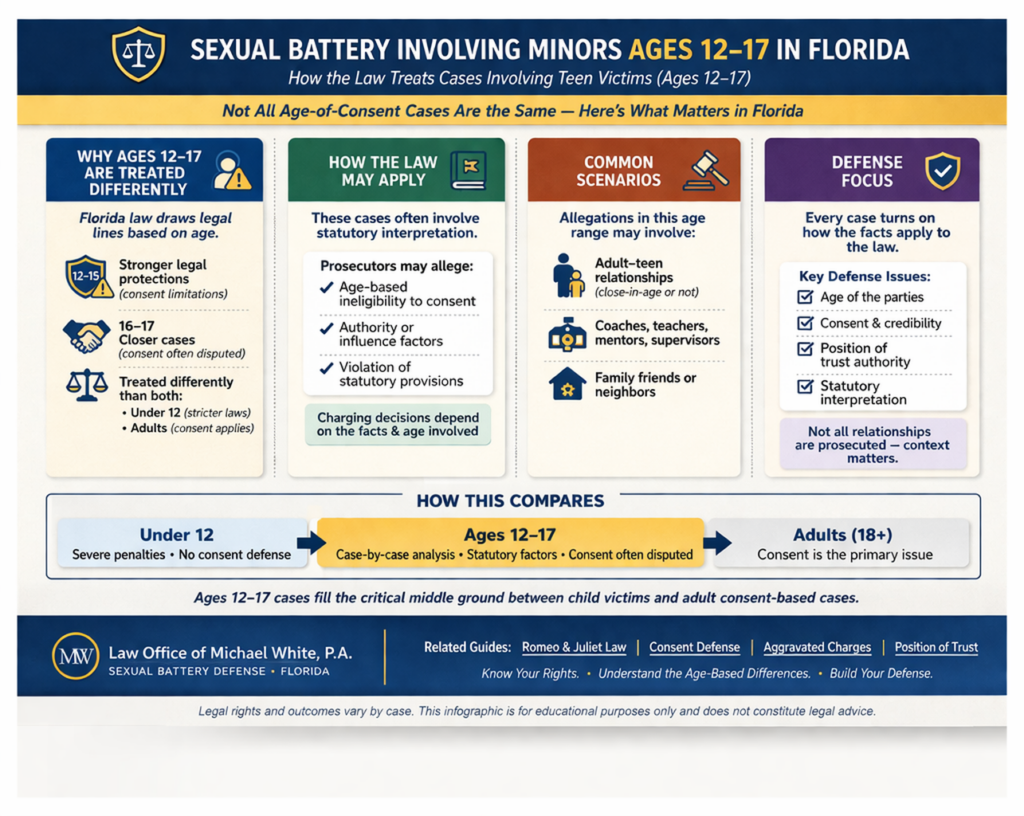
Sexual battery cases involving minors between the ages of 12 and 17 fall into a legally complex middle ground.
These cases are treated differently than:
- Allegations involving children under 12
- Cases involving adults
Instead, Florida law applies a fact-specific, statute-driven analysis that depends heavily on age, relationship, and circumstances.
For a broader overview of how sexual battery charges are prosecuted and defended, see our guide to Sexual Battery Charges in Florida.
❗ Why Ages 12–17 Are Treated Differently
Florida law recognizes that minors in this age range are not legally equivalent to adults — but they are also not treated the same as very young children.
As a result:
- Consent may be limited or legally restricted
- Age differences between the parties may become critical
- Certain relationships may trigger enhanced penalties
These cases often involve statutory interpretation, not just factual disputes.
🧠 Differences Within the 12–17 Age Range
Not all cases in this category are treated the same.
Ages 12–15
- Stronger statutory protections
- Greater limits on legal consent
- More likely to result in enhanced charges
Ages 16–17
- Closer to the age of consent
- Greater focus on context and relationship
- More likely to involve disputes over consent and credibility
⚠️ How Age Affects Charging Decisions
Charging decisions in these cases often depend on:
- The exact age of both parties
- The age difference between them
- Whether there was force, coercion, or authority
- Whether a position of trust is alleged
Depending on these factors, charges may range from:
- Standard sexual battery
- Lewd or lascivious offenses
- Enhanced or aggravated charges
For more on how enhancements apply, see our guide to Position of Trust Enhancements in Florida Sexual Battery Cases.
🔍 Common Allegation Scenarios
Cases involving minors ages 12–17 often arise in specific contexts:
- Peer or close-in-age relationships
- School or extracurricular settings
- Situations involving authority figures
- Digital or social media interactions
Each scenario requires a different legal analysis.
🔗 Consent and Age-Based Limitations
One of the most important issues in these cases is how consent is defined and limited by law.
Even where both parties appear to agree, Florida law may still impose restrictions based on age.
Understanding how consent applies is critical. See our guide to Consent Defense in Florida Sexual Battery Cases.
⚖️ Not Automatically a Life Felony — But Still Serious
Unlike cases involving very young children, allegations involving ages 12–17 are not automatically treated as the most extreme category of offense.
However, serious penalties may still apply depending on the facts.
For example:
- Aggravating factors may elevate the charge
- Certain cases may still involve life felony exposure
For a breakdown of those risks, see our guide to Aggravated Sexual Battery in Florida.
🛡️ Defense Strategies in Minor-Based Cases
Defense strategy in these cases often focuses on how the law applies to the specific facts.
Common approaches include:
Analyzing Age and Statutory Application
- Whether the law actually prohibits the alleged conduct
- Whether age-based provisions are correctly applied
Examining the Relationship
- Whether the interaction was consensual
- Whether authority or influence is being overstated
Challenging the Evidence
- Inconsistencies in statements
- Lack of corroboration
- Context of communications
Contextualizing the Case
- Nature of the relationship
- Timeline of events
- External influences
📞 Facing an Allegation Involving a Minor?
Cases involving minors ages 12–17 require careful analysis of both law and facts.
These are not one-size-fits-all cases — and the outcome often depends on how the statutory framework is applied to the specific situation.
❓ FREQUENTLY ASKED QUESTIONS ABOUT SEXUAL BATTERY INVOLVING MINORS
❓ Are all sexual battery cases involving minors treated the same?
No. Florida law treats cases differently depending on the age of the alleged victim and the specific circumstances involved.
❓ Can consent be a defense in cases involving minors?
It depends. In some cases, consent may be limited or legally restricted based on age and other statutory factors.
❓ Do these cases always involve life felony charges?
No. While serious penalties may apply, not all cases involving minors ages 12–17 are classified as life felonies.