
Last updated March 2026
🚨 The Most Serious Sexual Battery Charges in Florida
Sexual battery allegations involving a child under 12 represent the most serious category of sex crime charges under Florida law. Recent legislative changes have introduced the possibility of death penalty exposure in these cases — but the reality is far more complex.
While the law has expanded potential punishment, it is also the subject of ongoing constitutional challenges, meaning how these cases are ultimately handled is still evolving.
For a broader overview of how sexual battery charges are prosecuted and defended, see our guide to Sexual Battery Charges in Florida.
Sexual Battery Allegations Involving a Child Under 12 in Florida
Sexual battery cases involving a child under 12 are treated differently under Florida law because of the age of the alleged victim and the level of protection the law affords to minors. These cases are prosecuted more aggressively, carry enhanced penalties, and often involve statutory frameworks that remove or limit certain defenses that may exist in adult cases.
In practice, this means the State is not just evaluating whether a crime occurred — it is evaluating the case under a framework that assumes heightened vulnerability and increased culpability. As a result, these cases are far more likely to be charged at the highest felony levels, including life felonies and other enhanced classifications that carry mandatory sentencing consequences.
The statutory seriousness of these charges affects every stage of the case:
- Charging decisions are more aggressive
- Bond and pretrial release may be more restrictive
- Plea negotiations are more limited
- Sentencing exposure is significantly higher
Even before any discussion of capital punishment, a conviction in a case involving a child under 12 can result in life-altering penalties, including decades in prison and lifetime registration requirements.
While recent changes to Florida law have introduced the possibility of death penalty exposure in certain cases, that is only one part of the legal landscape. Not every case qualifies, and not every case will involve a capital prosecution.
In reality, most cases involving allegations with a child under 12 are litigated around whether the statutory elements are met, how the evidence is interpreted, and what level of sentencing exposure applies — not solely whether the death penalty will be pursued.
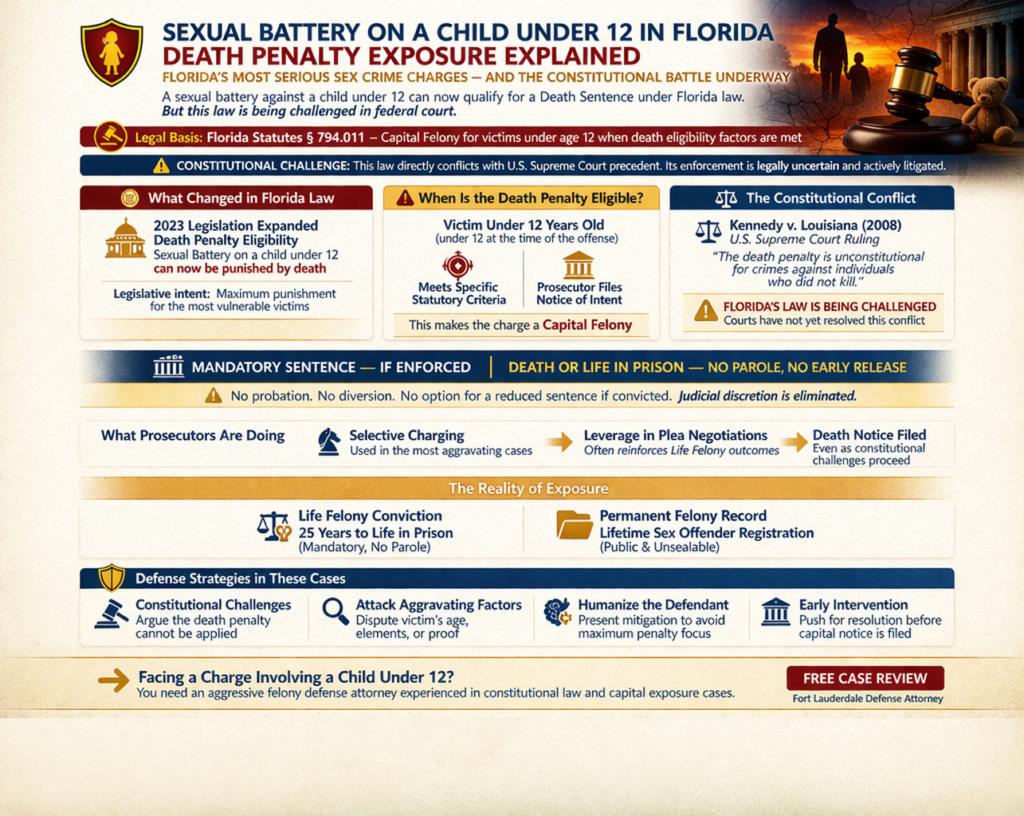
⚖️ What Changed in Florida Law?
Florida lawmakers have enacted statutes that allow prosecutors to pursue the death penalty in certain sexual battery cases involving victims under the age of 12.
Under these laws:
- The alleged victim must be under 12 years old
- The charge must meet specific statutory criteria
- Prosecutors may file a notice seeking capital punishment
If these conditions are met, the charge may be treated as a capital felony — the highest level of criminal offense under Florida law.
❗ When Can Sexual Battery Become Death-Penalty Eligible?
Not every allegation involving a minor qualifies.
To pursue the death penalty, prosecutors must establish:
- The victim was under 12 at the time of the alleged offense
- The statutory elements of sexual battery are satisfied
- Additional legal requirements for capital prosecution are met
Even then, the decision to seek the death penalty is discretionary, not automatic.
Many cases instead proceed under life felony exposure, which already carries severe penalties. For a breakdown of those sentencing risks, see our guide on Life Felony Exposure in Florida Sexual Battery Cases.
⚠️ The Constitutional Conflict: Is This Law Enforceable?
This is where things become critical.
The U.S. Supreme Court previously ruled in Kennedy v. Louisiana (2008) that the death penalty is unconstitutional for crimes where the victim does not die.
Florida’s new law directly challenges that precedent.
As a result:
- The issue is being litigated in courts
- The enforceability of the death penalty in these cases is uncertain
- Appeals and constitutional motions are expected in any case where death is sought
This makes early legal strategy essential — especially in cases involving aggravated sexual battery factors, which often form the basis for enhanced prosecution.
📊 What Prosecutors Are Actually Doing
In practice, prosecutors are using this law strategically.
Common approaches include:
- Filing enhanced charges to increase leverage
- Using potential capital exposure in plea negotiations
- Reserving death penalty filings for the most severe allegations
Even when the death penalty is not ultimately pursued, the threat of it can shape the entire case.
⛓️ The Real Exposure: What Defendants Actually Face
Even without a death sentence, the penalties are life-altering.
A conviction may result in:
- Life in prison or decades behind bars
- Mandatory minimum sentencing structures
- Lifetime sex offender registration
- Permanent felony record with no sealing eligibility
These consequences often overlap with aggravated charges and enhancements, making it critical to evaluate every element of the case carefully.
🛡️ Defense Strategy in Child Sexual Battery Cases
Cases involving child allegations require immediate, aggressive defense.
Key strategies often include:
Challenging the Legal Basis
- Arguing the death penalty cannot be constitutionally applied
- Filing pretrial motions to limit or strike capital exposure
Attacking the Evidence
- Scrutinizing forensic claims
- Examining inconsistencies in statements
- Identifying lack of corroborating evidence
Disputing Aggravating Factors
- Whether statutory criteria are actually met
- Whether enhancements are being over-applied
Early Intervention
- Engaging before formal charges escalate
- Positioning the case to avoid capital exposure entirely
📞 Facing a Sexual Battery Allegation Involving a Child?
These cases move fast — and the stakes could not be higher.
If you are under investigation or have been charged, early legal intervention can determine whether a case escalates to life felony exposure — or beyond.
❓ FAQs
❓ Can sexual battery lead to the death penalty in Florida?
Florida law now allows prosecutors to seek the death penalty in certain sexual battery cases involving victims under 12. However, this remains subject to constitutional challenges and is not yet fully settled law.
❓ Is Florida’s death penalty law for sexual battery constitutional?
It is currently being challenged. The U.S. Supreme Court has previously ruled that the death penalty is unconstitutional in cases where the victim did not die, creating a direct legal conflict with Florida’s statute.
❓ What do most defendants actually face in these cases?
In most cases, defendants face life felony exposure, including decades in prison, mandatory sentencing structures, and lifetime sex offender registration — even when the death penalty is not pursued.