
Last updated March 2026
⚖️ DNA Evidence Can Be Powerful — But It Is Not Always Decisive
DNA evidence often plays a major role in sexual battery investigations. To prosecutors, it can appear scientific, objective, and highly persuasive.
But DNA evidence does not always answer the most important question in the case.
In many sexual battery prosecutions, the real dispute is not whether contact occurred, but how it occurred, when it occurred, and whether it was consensual. DNA may support the claim that contact happened, yet still leave critical legal questions unresolved.
For a broader overview of how these charges are prosecuted and defended, see our guide to Sexual Battery Charges in Florida.
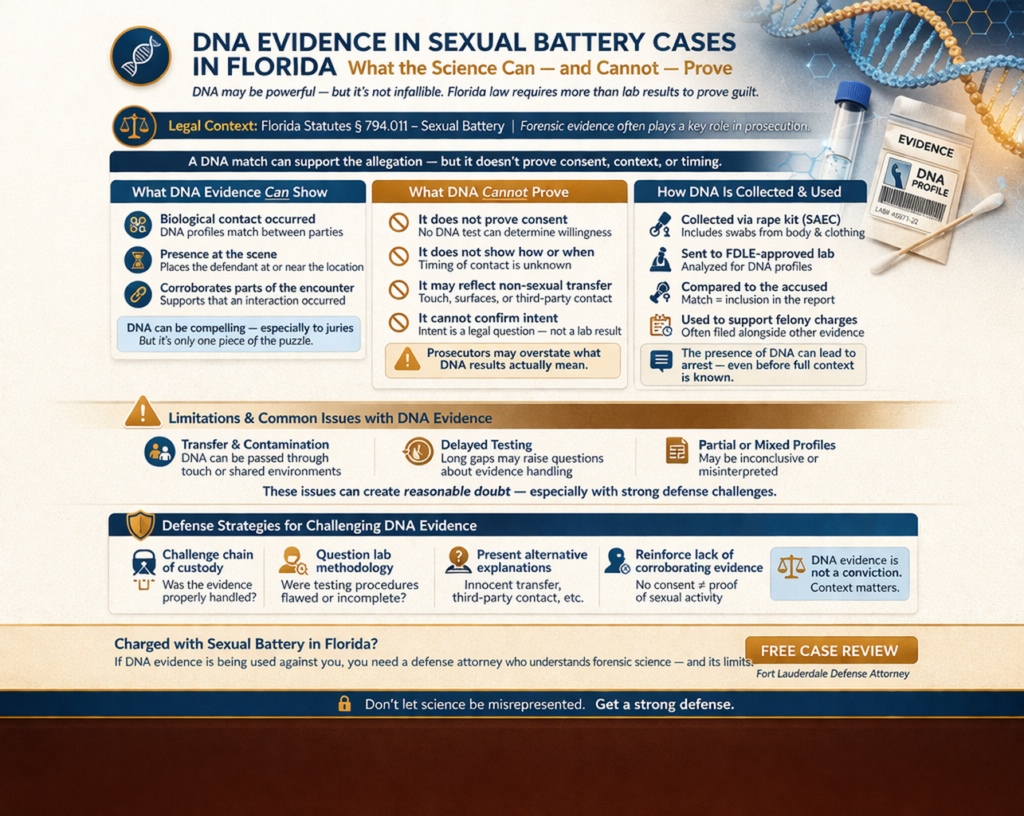
🧬 What DNA Evidence Can Prove
When properly collected and analyzed, DNA evidence may help establish:
- That biological material from a person was present
- That contact between two individuals likely occurred
- That a suspect cannot easily be excluded as a contributor
- That physical evidence is consistent with the State’s theory
In some cases, DNA evidence can be highly damaging — especially when it matches the accused and supports other evidence in the case.
But even then, the presence of DNA usually does not automatically prove force, lack of consent, or the timing of the alleged conduct.
❗ What DNA Evidence Cannot Prove by Itself
This is where many people misunderstand forensic evidence.
DNA may show that physical contact occurred, but standing alone it often cannot prove:
- Whether the contact was consensual
- Exactly when the contact occurred
- Whether the biological material was transferred directly or indirectly
- Whether the surrounding allegations are true in full
That is why DNA evidence must always be evaluated in context.
In many cases, the central issue remains whether the encounter was consensual. Learn more in our guide to Consent Defense in Florida Sexual Battery Cases.
⚠️ Common Problems With DNA Evidence
DNA evidence can look definitive on paper while still being vulnerable to challenge.
Contamination
Biological material can be compromised during collection, storage, transport, or testing.
Mixed Profiles
Some samples contain genetic material from more than one person, which can complicate interpretation and reduce certainty.
Transfer Issues
DNA can sometimes be deposited indirectly, rather than through the act alleged by the prosecution.
Limited Conclusions
A forensic report may show consistency with contact, but not necessarily with the State’s version of events.
🔍 How DNA Evidence Is Used in Sexual Battery Cases
In practice, prosecutors often rely on DNA evidence to strengthen credibility and corroborate an accusation.
But the defense must ask a more careful set of questions:
- What exactly was collected?
- When was it collected?
- Was the chain of custody properly maintained?
- Does the testing actually support the prosecution’s theory?
- Does the DNA evidence prove anything beyond contact?
In some cases, the State may overstate what forensic evidence really means.
This is especially important in cases involving false allegations, disputed timelines, or delayed reporting, where forensic evidence may be less conclusive than it first appears.
🧠 DNA Evidence and Credibility Issues
DNA does not eliminate credibility disputes.
A case may still turn on:
- Conflicting statements
- Inconsistent timelines
- Delayed accusations
- Lack of corroboration beyond contact
That is why forensic evidence is often just one part of a much larger case analysis.
For a closer look at how timing affects these cases, see our guide to Delayed Reporting in Sexual Battery Cases in Florida.
🛡️ Defense Strategies for Challenging DNA Evidence
A strong defense does not simply deny the existence of DNA. It challenges what the evidence actually proves.
Common defense strategies include:
Examining Collection Procedures
Errors during swabbing, packaging, storage, or transport may undermine reliability.
Reviewing Laboratory Interpretation
Mixed samples, low-level DNA, and ambiguous conclusions may be more vulnerable than prosecutors suggest.
Placing DNA in Context
Even accurate DNA results may be consistent with consensual contact or with contact occurring at a different time than alleged.
Comparing Forensics to the Full Timeline
Messages, witness accounts, and other contextual evidence may show that the forensic story is incomplete or misleading.
In cases involving credibility concerns, this analysis often overlaps with the issues discussed in our guide to False Allegations of Sexual Battery in Florida.
⛓️ What Happens If DNA Evidence Is Believed
If jurors view DNA evidence as confirming the prosecution’s version of events, the consequences can be severe.
Depending on the allegations, a conviction may lead to:
- Lengthy or life-level prison exposure
- Mandatory sentencing consequences
- Lifetime sex offender registration
- Permanent damage to reputation and future opportunities
Because forensic evidence can carry so much weight, it must be carefully analyzed early and aggressively challenged when appropriate.
📞 Under Investigation in a Sexual Battery Case?
DNA evidence can be one of the most important parts of a sexual battery prosecution — but it is rarely the whole case.
The real question is not just whether DNA exists, but what it actually proves, what it does not prove, and whether the State is overstating its significance.
❓ FREQUENTLY ASKED QUESTIONS ABOUT DNA EVIDENCE IN SEXUAL BATTERY CASES
❓ Does DNA evidence prove sexual battery happened?
Not by itself. DNA may show that contact occurred, but it does not automatically prove force, lack of consent, or when the contact took place.
❓ Can DNA evidence be challenged in a Florida sexual battery case?
Yes. DNA evidence may be challenged based on contamination, mixed profiles, collection errors, chain-of-custody problems, or overstatement of what the results actually prove.
❓ Is DNA evidence always required to convict someone of sexual battery?
No. Prosecutors can pursue sexual battery charges even without DNA evidence, especially when they rely heavily on statements and credibility.