
Last updated March 2026
In Florida, simply displaying or pointing a firearm during an argument can instantly escalate a situation into a serious felony. What many people don’t realize is that a person can be charged even if the gun was never fired — and even if no one was physically injured.
Aggravated assault with a firearm is prosecuted aggressively throughout Broward County and South Florida, and it falls within the broader category of felony assault offenses explained in our guide to Aggravated Assault Charges in Florida. These cases often move quickly — and early decisions can have long-term consequences.
⚖️ What Is Aggravated Assault with a Firearm?
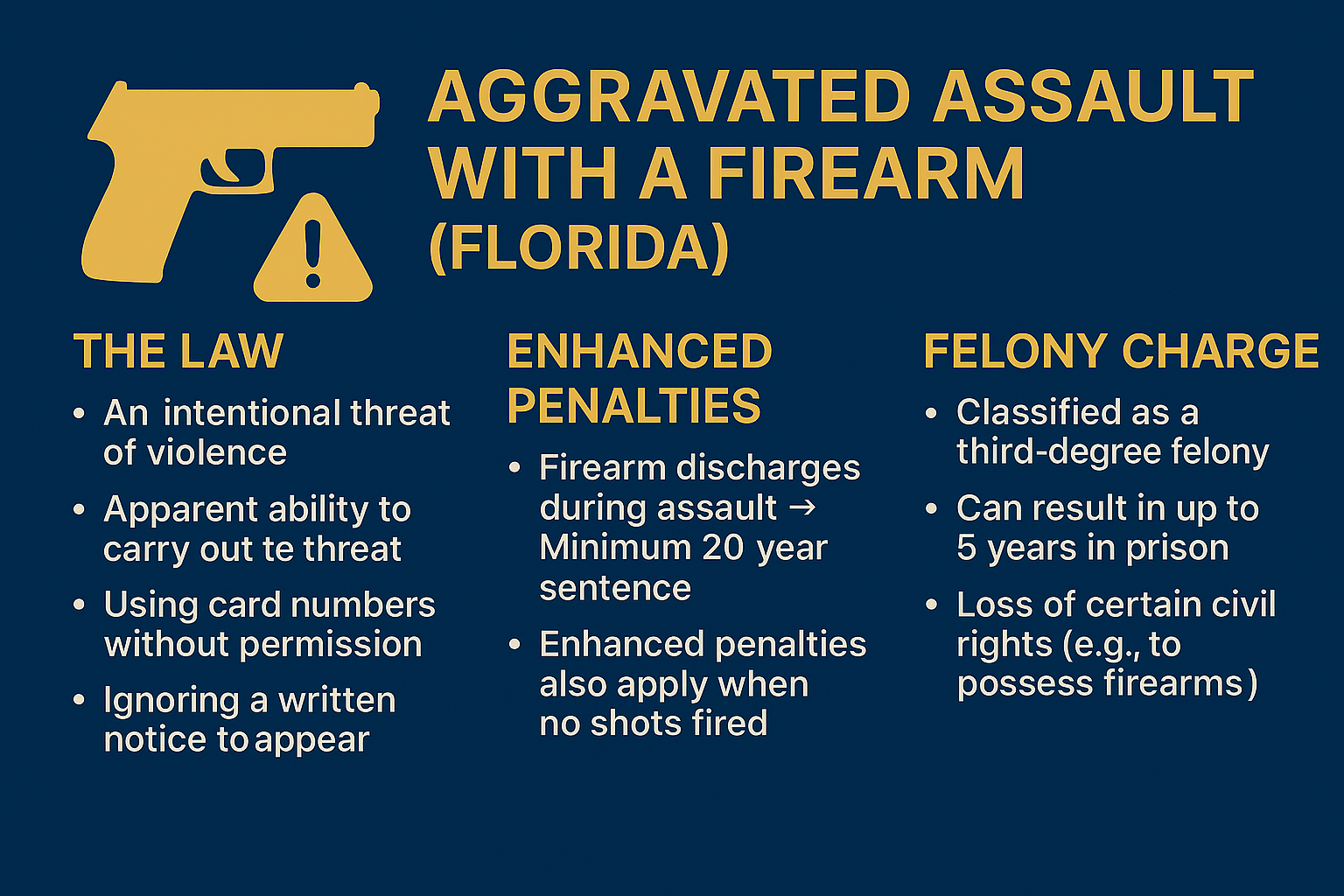
Under Florida law, aggravated assault occurs when a person intentionally threatens violence, has the apparent ability to carry it out, and creates a well-founded fear of imminent harm — combined with the use of a deadly weapon.
When a firearm is involved, prosecutors often treat the case as significantly more serious, even if:
The weapon was never discharged
No physical contact occurred
No one was actually injured
Because the charge is based on perception and intent rather than injury, these cases frequently turn on how the alleged victim interpreted the situation — and whether that interpretation was reasonable.
🔫 Does the Gun Have to Be Fired?
No.
A firearm does not have to be fired — or even used — to support an aggravated assault charge. In many cases, the allegation is based solely on displaying or pointing a weapon during an argument. Whether that conduct rises to the level of a felony often depends on context, intent, and how the situation was perceived. For a deeper explanation of how Florida courts analyze these scenarios, see When Pointing a Gun Becomes Aggravated Assault in Florida.
In some situations, what appears to be a threat may actually be a defensive reaction — particularly in fast-moving confrontations. These issues often overlap with Florida’s self-defense laws, including Stand Your Ground immunity, which can allow a case to be dismissed before trial.
🔍 What Counts as a “Firearm” Under Florida Law?
Not every object that looks like a gun is treated the same under Florida law.
Courts may distinguish between:
Real, operable firearms
Inoperable guns
BB guns or pellet guns
Airsoft or replica weapons
Whether an object qualifies as a “deadly weapon” depends on its capability and how it was used. These distinctions can be critical in determining whether a felony charge is legally justified. For a deeper look at how courts analyze these issues, see our guide to AggravatedAssault Involving BB Guns and Airsoft Weapons.
⚖️ Florida’s 10–20–Life Law: Mandatory Minimum Sentences
One of the most serious aspects of aggravated assault with a firearm is the potential application of Florida’s 10–20–Life law.
If the State applies this enhancement:
Displaying or possessing a firearm can trigger a 10-year mandatory minimum sentence
Discharging a firearm can trigger a 20-year mandatory minimum
Discharging a firearm and causing injury can result in 25 years to life
These sentences are mandatory if applied. Judges cannot go below them.
However — and this is critical — prosecutors decide whether to charge the enhancement. That means early legal advocacy can sometimes prevent mandatory minimums from attaching in the first place.
🚗 How These Cases Commonly Arise
Aggravated assault with a firearm charges often come from situations that escalate quickly, including:
Heated verbal arguments
Road-rage confrontations
Disputes between acquaintances or neighbors
Domestic-related incidents
For example, in road-rage situations, a driver may claim that a firearm was displayed during a confrontation — even if no threat was intended. These fact patterns are explored more fully in our analysis of road rage aggravated assault cases in Florida.
Because these incidents unfold quickly, they are often based on incomplete or conflicting accounts — making early investigation essential.
🔍 How Prosecutors Try to Prove the Case
To convict someone of aggravated assault with a firearm, the State must prove:
An intentional and unlawful threat
Apparent ability to carry out the threat
A well-founded fear of imminent violence
Use of a deadly weapon
Unlike many other crimes, these cases often rely heavily on:
Witness testimony
Body camera footage
911 calls
Conflicting statements
There is often no physical evidence — and no injury — which means credibility and context become the central issues.
🛡️ Legal Defenses to Aggravated Assault with a Firearm
Every case is fact-specific, but strong defenses often include:
✔ Self-Defense
Florida law allows the use (or threatened use) of force to prevent imminent harm. If the alleged victim was the aggressor, the charge may not stand.
✔ Stand Your Ground Immunity
Under Florida law, you may have the right to avoid prosecution entirely if the threat or use of force was legally justified. Learn how immunity works — and what prosecutors attack — in Self-Defense and Stand Your Ground in Florida.
✔ Lack of Intent
If you did not intentionally threaten violence — for example, accidental display or negligent handling — the charge may fail.
✔ No Reasonable Fear
The alleged victim must have experienced a well-founded fear. If their reaction was exaggerated, inconsistent, or unsupported, prosecutors may struggle to prove the case.
✔ No Real Firearm
BB guns, airsoft guns, toys, or inoperable weapons may not qualify as “firearms” under Florida law.
✔ Evidentiary Challenges
Chain of custody
Surveillance interpretation
Faulty identifications
Witness inconsistencies
Bodycam or lack of video
A skilled defense attorney can use these issues to push for dismissals or charge reductions.
In many situations, these weaknesses lead to reduced charges or negotiated resolutions that avoid felony convictions. For example, some cases are resolved as improper exhibition of a weapon or simple assault rather than aggravated assault. A closer look at how these outcomes happen — and what factors influence prosecutors — is explained in our guide to How Aggravated Assault Charges Get Reduced in Florida.
⚖️ Can These Charges Be Reduced or Dropped?
Yes — and often before trial.
Many aggravated assault with a firearm cases are resolved through:
Charge reductions
Pretrial negotiations
Dismissals based on insufficient evidence
Self-defense immunity hearings
Because prosecutors control charging decisions — including whether to pursue firearm enhancements — early intervention can significantly affect the outcome.
📍 Arrested for Aggravated Assault with a Firearm in Fort Lauderdale?
A firearm allegation does not automatically mean prison.
At Michael White, P.A., we bring former prosecutor insight to every case. We understand how these charges are built — and where they break down.
Early action can:
Prevent mandatory minimum sentences
Challenge firearm classification
Preserve surveillance and witness evidence
Position the case for reduction or dismissal
If you are facing an aggravated assault charge, what you do next matters.
🟡 Call (954) 270-0769 for a free consultation
🟢 Protect your rights before charges become convictions
❓FAQs
Q1: Is aggravated assault with a firearm a felony in Florida?
A: Yes. Aggravated assault with a firearm is a third-degree felony under § 784.021, but the firearm enhancement also invokes Florida’s 10-20-Life statute (§ 775.087). That means mandatory minimum prison terms, even if you didn’t fire the gun.
Q2: Can I go to jail even if I didn’t shoot the gun?
A: Absolutely. Simply pointing or brandishing a firearm in a threatening way can trigger a 10-year minimum sentence under 10-20-Life. Prosecutors often push for prison time unless the defense negotiates lesser charges.
Q3: What is the difference between aggravated assault and aggravated assault with a firearm?
A: Standard aggravated assault may involve a deadly weapon or intent to commit a felony. When that weapon is a firearm, the 10-20-Life law applies — creating non-negotiable minimum sentences and escalating the stakes dramatically.
Q4: Can I claim self-defense if I pulled a gun?
A: Yes. If you reasonably believed you were in danger of death or great bodily harm, you may argue self-defense. Florida’s Stand Your Ground law (§ 776.012) may also provide immunity from prosecution.
Q5: What should I do if I’m arrested for this charge?
A: Do not speak to law enforcement without counsel. Anything you say can be used against you. Contact a weapons crimes defense attorney immediately to challenge the State’s case and explore defenses like self-defense, lack of intent, or mistaken identity.